रसायन विज्ञान की समयरेखा
नेविगेशन पर जाएँ
खोज पर जाएँ

 | यह सम्पूर्ण पृष्ठ या इसके कुछ अनुभाग हिन्दी के अतिरिक्त अन्य भाषा(ओं) में भी लिखे गए हैं। आप इनका साँचा:edit करके विकिपीडिया की सहायता कर सकते हैं। |

इस समयरेखा में उन महत्वपूर्ण कृतियों, खोजों, विचारों एवं प्रयोगों को सूचीबद्ध किया गया है जिनके कारण पदार्थों की संरचना एवं उनके परस्पर क्रियाओं से सम्बन्धित मानव के ज्ञान में पर्याप्त वृद्धि हुई तथा जिसे आधुनिक विज्ञान में "रसायन विज्ञान" के नाम से जाना जाता है। यद्यपि रसायन विज्ञान की जड़ें ज्ञात इतिहास के आरम्भ काल तक पहुँची हुई हैं तथापि प्राय: आधुनिक रसायन के इतिहास का आरम्भ आयरलैण्ड के रसायनशास्त्री रॉबर्ट बॉयल से माना जाता है।
१७वीं शती से पूर्व


चीन के दुनहुआंग नगर से प्राप्त १०वीं शताब्दी का एक चित्र जिसमें एक बन्दूक और ग्रेनेड चित्रित हैं (ऊपर, दाएँ तरफ); यह बन्दूक और ग्रेनेड को चित्रित करने वाला सबसे पुराना ज्ञात चित्र है।

- 815 ई
- फारस के अलकेमी गेबर (Geber), ने रसायन विज्ञान के लिये पहली बार वैज्ञानिक विधि विकसित किया। उे हाइड्रोक्लोरिक अम्ल सहित अनेकों अम्ल अलग किये।
- 850 ई
- अल-किन्दी नामक अरब के रसायनज्ञ ने अलकेमी की आलोचना की तथा "पारस पत्थर" (Philosopher's stone) के सिद्धान्त को गलत बताया।
- 1267 ई
- रोजर बैकन (Roger Bacon) ने Opus Maius प्रकाशित किया जिसमें 'वैज्ञानिक विधि' का प्रारम्भिक स्वरूप विद्यमान था। इसी में बारूद से सम्बन्धित उसके प्रयोगों के परिणाम भी थे[१]
१७वी तथा १८वीं शताब्दी
- 1648
- जन बैप्टिस्ट वान हेल्मोन्ट (Jan Baptist van Helmont) की मृत्यु के पश्चात उसकी पुस्तक Ortus medicinae प्रकाशित हुई। कुछ विद्वानों का विचार है कि इस पुस्तक ने अलकेमी से केमिस्ट्री में पदार्पन की नींव डाली। इसका रॉबर्ट बायल पर भी बहुत असर पड़ा।[२]

- 1661
- रॉबर्ट बॉयल (Robert Boyle) ने द स्केप्टिकल केमिस्ट" (The Sceptical Chymist) प्रकाशित की। इसमें अलकेमी और केमिस्ट्री में भेद बताया गया था।[३]
- 1662
- रॉबर्ट बॉयल ने बॉयल का नियम प्रतिपादित किया जिसमें गैसों के व्यवहार का प्रायोगिक वर्णन था[३]
- 1754
- जोसेफ ब्लैक कार्बन डाईआक्साइड अलग करने में सफल[४]
- 1758
- जोसेफ ब्लैक ने गुप्त उष्मा (latent heat) के कांसेप्ट की व्याक्या की।[५]
- 1766
- हेनरी कैवेंडिश (Henry Cavendish) ने हाइड्रोज की खोज की।
- 1773-1774
- शीले (Carl Wilhelm Scheele) और जोसेफ प्रिस्टले (Joseph Priestly) ने स्वतंत्र रूप से आक्सीजन को अलग (isolate) किया।[६][७]
- 1778
- लैवाशिये (Antoine Lavoisier) ने आक्सीजन की पहचान की और इसका नामकरण किया। उसने ज्वलन में इसकी भूमिका को भी पहचाना।[८]
- 1787
- लैवाशिये ने Méthode de nomenclature chimique, का प्रकाशन किया जो रासायनिक नामकरण की प्रथम पद्धति थी।[८]
- 1787
- जैकूअस चार्ल्स (Jacques Charles) ने चार्ल्स का नियम प्रतिपादित किया।[९]
- 1789
- लैवाशिये नेआधुनिक रसायन विज्ञान की पहली पाठ्यपुस्तक Traité Élémentaire de Chimie प्रकाशित की।[८][१०]
१९वीं शती

- 1803
- जॉन डाल्टन (John Dalton) ने डाल्टन का नियम प्रतिपादित किया।[१२]
- 1805
- गे लुसाक (Joseph Louis Gay-Lussac) ने पाया कि जल आयतन के अनुसार दो भाग हाइड्रोजन एवं एक भाग आक्सीजन से मिलकर बना है।
- 1808
- गे लुसाक ने वायु एवं अन्य कई गैसें एकत्र की तथा उनके भौतिक एवं रासायनिक गुणों की खोज की। उसने बायल के नियम तथा चार्ल्स के नियम की प्रायोगिक पुष्टि भी की। उसने गैसों के घनत्व एवं उनकी संरचना का सम्बन्ध भी बताया.[१३]
- 1808
- John Dalton publishes New System of Chemical Philosophy, which contains first modern scientific description of the atomic theory, and clear description of the law of multiple proportions.[१२]
- 1808
- Jöns Jakob Berzelius publishes Lärboki Kemien in which he proposes modern chemical symbols and notation, and of the concept of relative atomic weight.[१४]
- 1811
- Amedeo Avogadro proposes Avogadro's law, that equal volumes of gases under constant temperature and pressure contain equal number of molecules.[१५]

- 1825
- Friedrich Wöhler and Justus von Liebig perform the first confirmed discovery and explanation of isomers, earlier named by Berzelius. Working with cyanic acid and fulminic acid, they correctly deduce that isomerism was caused by differing arrangements of atoms within a molecular structure.[१६]
- 1827
- William Prout classifies biomolecules into their modern groupings: carbohydrates, proteins and lipids.[१७]
- 1828
- Friedrich Wöhler synthesizes urea, thereby establishing that organic compounds could be produced from inorganic starting materials, disproving the theory of vitalism.[१६]
- 1832
- Friedrich Wöhler and Justus von Liebig discover and explain functional groups and radicals in relation to organic chemistry.[१६]
- 1840
- Germain Hess proposes Hess's Law, an early statement of the Law of conservation of energy, which establishes that energy changes in a chemical process depend only on the states of the starting and product materials and not on the specific pathway taken between the two states.[१८]
- 1847
- Hermann Kolbe obtains acetic acid from completely inorganic sources, further disproving vitalism.[१९]
- 1848
- Lord Kelvin establishes concept of absolute zero, the temperature at which all molecular motion ceases.[२०]
- 1849
- Louis Pasteur discovers that the racemic form of tartaric acid is a mixture of the levorotatory and dextrotatory forms, thus clarifying the nature of optical rotation and advancing the field of stereochemistry.[२१]
- 1852
- August Beer proposes Beer's law, which explains the relationship between the composition of a mixture and the amount of light it will absorb. Based partly on earlier work by Pierre Bouguer and Johann Heinrich Lambert, it establishes the analytical technique known as spectrophotometry.[२२]
- 1855
- Benjamin Silliman, Jr. pioneers methods of petroleum cracking, which makes the entire modern petrochemical industry possible.[२३]
- 1856
- William Henry Perkin synthesizes Perkin's mauve, the first synthetic dye. Created as an accidental byproduct of an attempt to create quinine from coal tar. This discovery is the foundation of the dye synthesis industry, one of the earliest successful chemical industries.[२४]
- 1857
- Friedrich August Kekulé von Stradonitz proposes that carbon is tetravalent, or forms exactly four chemical bonds.[२५]
- 1859-1860
- Gustav Kirchhoff and Robert Bunsen lay the foundations of spectroscopy as a means of chemical analysis, which lead them to the discovery of caesium and rubidium. Other workers soon used the same technique to discover indium, thalium, and helium.[२६]
- 1860
- Stanislao Cannizzaro, resurrecting Avogadro's ideas regarding diatomic molecules, compiles a table of atomic weights and presents it at the 1860 Karlsruhe Congress, ending decades of conflicting atomic weights and molecular formulas, and leading to Mendeleev's discovery of the periodic law.[२७]
- 1862
- Alexander Parkes exhibits Parkesine, one of the earliest synthetic polymers, at the International Exhibition in London. This discovery formed the foundation of the modern plastics industry.[२८]
- 1862
- Alexandre-Émile Béguyer de Chancourtois publishes the telluric helix, an early, three-dimensional version of the Periodic Table of the Elements.[२९]
- 1864
- John Newlands proposes the law of octaves, a precursor to the Periodic Law.[२९]
- 1864
- Lothar Meyer develops an early version of the periodic table, with 28 elements organized by valence.[३०]
- 1864
- Cato Maximilian Guldberg and Peter Waage, building on Claude Louis Berthollet’s ideas, proposed the Law of Mass Action.[३१][३२][३३]
- 1865
- Johann Josef Loschmidt determines exact number of molecules in a mole, later named Avogadro's Number.[३४]
- 1865
- Friedrich August Kekulé von Stradonitz, based partially on the work of Loschmidt and others, establishes structure of benzene as a six carbon ring with alternating single and double bonds.[२५]
- 1865
- Adolf von Baeyer begins work on indigo dye, a milestone in modern industrial organic chemistry which revolutionizes the dye industry.[३५]

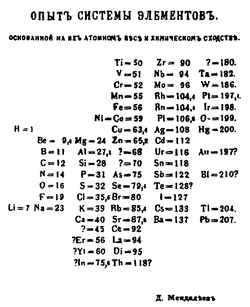
Mendeleev's 1869 Periodic Table.
- 1869
- Dmitri Mendeleev publishes the first modern periodic table, with the 66 known elements organized by atomic weights. The strength of his table was its ability to accurately predict the properties of as-yet unknown elements.[२९][३०]
- 1873
- Jacobus Henricus van 't Hoff and Joseph Achille Le Bel, working independently, develop a model of chemical bonding that explains the chirality experiments of Pasteur and provides a physical cause for optical activity in chiral compounds.[३६]
- 1876
- Josiah Willard Gibbs publishes On the Equilibrium of Heterogeneous Substances, a compilation of his work on thermodynamics and physical chemistry which lays out the concept of free energy to explain the physical basis of chemical equilibria.[३७]
- 1877
- Ludwig Boltzmann establishes statistical derivations of many important physical and chemical concepts, including entropy, and distributions of molecular velocities in the gas phase.[३८]
- 1883
- Svante Arrhenius develops ion theory to explain conductivity in electrolytes.[३९]
- 1884
- Jacobus Henricus van 't Hoff publishes Études de Dynamique chimique, a seminal study on chemical kinetics.[४०]
- 1884
- Hermann Emil Fischer proposes structure of purine, a key structure in many biomolecules, which he later synthesized in 1898. Also begins work on the chemistry of glucose and related sugars.[४१]
- 1884
- Henry Louis Le Chatelier develops Le Chatelier's principle, which explains the response of dynamic chemical equilibria to external stresses.[४२]
- 1885
- Eugene Goldstein names the cathode ray, later discovered to be composed of electrons, and the canal ray, later discovered to be positive hydrogen ions that had been stripped of their electrons in a cathode ray tube. These would later be named protons.[४३]
- 1893
- Alfred Werner discovers the octahedral structure of cobalt complexes, thus establishing the field of coordination chemistry.[४४]
- 1894-1898
- William Ramsay discovers the noble gases, which fill a large and unexpected gap in the periodic table and led to models of chemical bonding.[४५]
- 1897
- J. J. Thomson discovers the electron using the cathode ray tube.[४६]
- 1898
- Wilhelm Wien demonstrates that canal rays (streams of positive ions) can be deflected by magnetic fields, and that the amount of deflection is proportional to the mass-to-charge ratio. This discovery would lead to the analytical technique known as mass spectrometry.[४७]
- 1898
- Maria Sklodowska-Curie and Pierre Curie isolate radium and polonium from pitchblende.[४८]
- c. 1900
- Ernest Rutherford discovers the source of radioactivity as decaying atoms; coins terms for various types of radiation.[४९]
२०वीं शताब्दी
- 1905
- फ्रिट्ज हैबर (Fritz Haber) और कार्ल बॉश (Carl Bosch) ने अमोनिया निर्माण के लिये हैबर प्रक्रम (Haber process) का विकास किया।[५०]
- 1907
- लिओ हेन्ड्रिक बैकीण्ड (Leo Hendrik Baekeland) ने बैकेलाइट (bakelite) की खोज की[५१]
- 1909
- अर्नेस्ट रदरफोर्ड, हंस गीगर (Hans Geiger) और अर्नेस्ट मार्सडेन (Ernest Marsden) ने स्वर्ण पन्नी वाला प्रयोग किया जिसने परमाणु के नाभिकीय मॉडल को सिद्ध किया।[४९]

- 1913
- नील्स बोर (Niels Bohr) ने परमाणु संरचना में क्वांटम यांत्रिकी के कांसेप्ट का सहारा लिया।[५२]
- 1932
- जेम्स चैडविक ने न्यूट्रॉन की खोज की।[५३]
- 1938
- आटो हान (Otto Hahn) ने यूरेनियम एवं थोरियम में नाभिकीय फिशन (nuclear fission) की खोज की। ]][५४]
- 1953
- वाट्सन (James D. Watson) और क्रिक (Francis Crick) ने डीएनए (DNA) का का मॉडल प्रस्तुत किया। जिससे आणविक जीवविज्ञान के द्वार खुल गये।[५५]

- १९८५
- हेरॉल्ड क्रोटो, रॉबर्ट कर्ल तथा रिचर्ड स्माली ने फुलरीन (fullerenes) की खोज की। फुलरीन विशाल कार्बन अणुओं वाला एक श्रेणी है जो मोटे तौर पर बकमिन्स्टर फुलर द्वार डिजाइन किए गए जियोडेसिक डोम के आकार से मिलता-जुलते आकार वाला है।
सन्दर्भ
इन्हें भी देखें
बाहरी कड़ियाँ
- Indian Chemistry Through The Ages by D.P. Agrawal
- Ancient indian Chemistry
- Chemical Achievers: The Human Face of the Chemical Sciences
- Eric Weisstein's World of Scientific Biography
- History of Gas Chemistry
- list of all Nobel Prize laureates
- History of Elements of the Periodic Table
- Chemsoc timeline
- ↑ साँचा:cite web
- ↑ साँचा:cite web
- ↑ अ आ साँचा:cite web
- ↑ साँचा:cite web
- ↑ साँचा:cite book
- ↑ साँचा:cite web
- ↑ साँचा:cite web
- ↑ अ आ इ साँचा:cite web
- ↑ साँचा:cite web
- ↑ साँचा:cite book
- ↑ साँचा:cite web
- ↑ अ आ साँचा:cite web
- ↑ साँचा:cite web
- ↑ साँचा:cite web
- ↑ साँचा:cite web
- ↑ अ आ इ साँचा:cite web
- ↑ साँचा:cite web
- ↑ साँचा:cite web
- ↑ साँचा:cite web
- ↑ साँचा:cite web
- ↑ साँचा:cite web
- ↑ साँचा:cite web
- ↑ साँचा:cite web
- ↑ साँचा:cite web
- ↑ अ आ साँचा:cite web
- ↑ साँचा:cite web
- ↑ Eric R. Scerri, The Periodic Table: Its Story and Its Significance, Oxford University Press, 2006.
- ↑ साँचा:cite web
- ↑ अ आ इ साँचा:cite web
- ↑ अ आ साँचा:cite web
- ↑ C.M. Guldberg and P. Waage,"Studies Concerning Affinity" C. M. Forhandlinger: Videnskabs-Selskabet i Christiana (1864), 35
- ↑ P. Waage, "Experiments for Determining the Affinity Law", Forhandlinger i Videnskabs-Selskabet i Christiania, (1864) 92.
- ↑ C.M. Guldberg, "Concerning the Laws of Chemical Affinity", C. M. Forhandlinger i Videnskabs-Selskabet i Christiania (1864) 111
- ↑ साँचा:cite episode
- ↑ साँचा:cite web
- ↑ साँचा:cite web
- ↑ साँचा:cite web
- ↑ साँचा:cite web
- ↑ साँचा:cite web
- ↑ साँचा:cite web
- ↑ साँचा:cite web
- ↑ साँचा:cite web
- ↑ साँचा:cite web
- ↑ साँचा:cite web
- ↑ साँचा:cite web
- ↑ साँचा:cite web
- ↑ साँचा:cite web
- ↑ साँचा:cite web
- ↑ अ आ साँचा:cite web
- ↑ साँचा:cite web
- ↑ साँचा:cite web
- ↑ साँचा:cite web
- ↑ साँचा:cite web
- ↑ साँचा:cite web
- ↑ साँचा:cite web